

The Overview
In Ontario’s real estate market, especially the GTA, transit expansion consistently shows a measurable impact on condo prices. This is supported by housing data, academic research, and real project performance across Toronto LRTs, subway extensions, and GO Transit upgrades.
The relationship is simple: better transit access increases demand, reduces travel friction, and raises what buyers are willing to pay for nearby housing.
1. Condo Prices Increase 2 to 10 Percent Near New Transit
Across North American studies and Toronto-specific models, proximity to higher-order transit such as subway and LRT consistently increases residential property values.
A Toronto-focused transit study found that improved transit accessibility led to approximately 2.7 percent condominium price increases in affected corridors compared to control areas after service improvements were introduced.
Other Ontario planning studies estimate broader impacts:
- 8 to 10 percent residential property value increase in areas near new LRT infrastructure
- Higher increases for condo developments compared to low-rise housing due to stronger transit demand
These findings show a consistent pattern. Transit proximity is quickly reflected in housing prices after announcements and more strongly after completion.
2. Real Example: Eglinton Crosstown LRT and Condo Value Growth
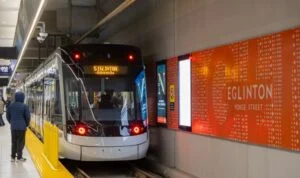
One of the strongest real-world case studies is the Eglinton Crosstown LRT corridor in Toronto.
Over the past several years, condo values along parts of the line have increased by:
- Up to 135 percent growth in some segments of the corridor
- Compared to roughly 72 percent citywide condo market growth over the same period
This demonstrates a key trend. Transit-adjacent condos often outperform the broader market by a wide margin.
Even before completion, future station effects influence investor demand and pricing.
3. Transit Accessibility Directly Impacts Condo Pricing
Modern real estate models measure not only distance to transit but overall accessibility improvement across the network.
Research using Toronto transit data found that:
- Transit accessibility is a statistically significant driver of condo pricing
- Price growth is linked to reduced travel time and improved connectivity
- Even small improvements in service frequency or speed can increase property values
In simple terms, it is not only how close you are to transit but how much faster it makes commuting.
4. Rail Transit Creates Long Term Value Uplift Zones
Transit infrastructure creates value uplift zones, areas where land prices increase due to expected long-term accessibility improvements.
In Toronto and comparable Canadian cities:
- Properties near urban rail stations consistently show higher resale values
- The impact varies depending on station type, with subway having the strongest effect
- Condo-heavy zones see stronger appreciation than low-density areas
Historically, Toronto subway expansions have shown similar patterns, where commuting savings are reflected in housing prices over time.
5. Transit Expansion Drives Pre-Construction Price Growth
One of the most important effects is timing.
Condo prices often rise in three stages:
- Announcement phase where investors enter early based on future station plans
- Construction phase where timelines and feasibility become clearer
- Completion phase where end-user demand increases sharply
This is why transit-linked condo projects in Ontario often see price growth years before service begins.
6. The Network Effect Multiplies Price Growth
Transit expansion does not only affect properties next to stations.
It improves the entire system by:
- Connecting suburbs to downtown faster
- Reducing congestion on major routes
- Increasing job accessibility across the region
As accessibility improves across multiple nodes, secondary areas also experience price growth, not just immediate station zones.
7. Why Condos Benefit More Than Houses
Transit expansion tends to have a stronger impact on condos because:
- Condo buyers are more likely to rely on transit
- Investors prioritize rental demand near stations
- Density aligns with transit-oriented development planning
- Reduced car ownership increases demand for walkable transit access
As a result, condos near transit corridors often outperform low-rise housing in both demand and appreciation.
Conclusion
Transit expansion in Ontario is one of the most reliable long-term drivers of condo price appreciation.
Across studies and real projects, the market consistently shows:
- 2 to 10 percent baseline value uplift near transit
- 2.7 percent measurable corridor-specific price gains
- Up to 135 percent growth in major LRT corridors such as Eglinton
- Stronger performance for condos than traditional housing
For buyers and investors, the takeaway is clear:
Transit is not just infrastructure. It is a major driver of real estate pricing.
Explore Pre-Construction Projects
Browse condos and homes now selling and coming soon across Ontario.