

What’s Hapenning?
Uncertainty has always been one of the biggest barriers in preconstruction real estate, especially when it comes to hidden costs and tax exposure. Right now, Claystone Condos in Oakville is addressing both of those concerns directly, while also standing out for another reason that many buyers overlook: the strength of the development team behind it.
A Developer Partnership That Adds Real Confidence
Claystone is being developed by Graywood Developments in partnership with Hankyu Hanshin Properties.
This isn’t just a technical detail, it matters.
- Graywood brings deep experience in the GTA market, with a track record of delivering residential communities across Canada
- Hankyu Hanshin adds global scale, institutional capital, and long-term development expertise from Japan
In a market where many projects are being delayed or cancelled due to financing challenges, a well-capitalized joint venture significantly reduces execution risk. That’s something buyers should pay attention to, especially in today’s environment.
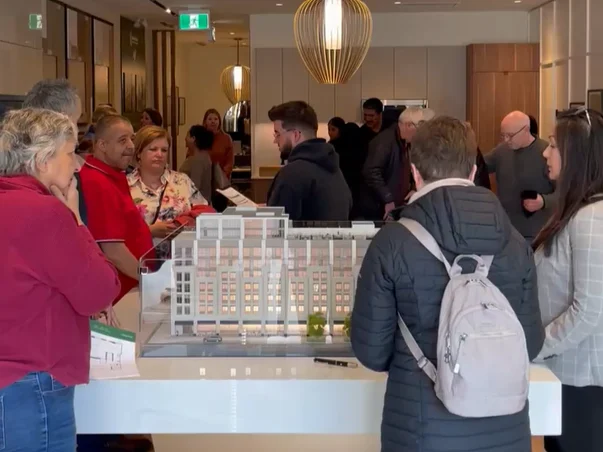
Claystone Condos Event
Eliminating Two Major Buyer Concerns
At Claystone, two of the most common financial uncertainties in preconstruction have been minimized:
1. No Closing Costs (Limited Time)
For a limited period, buyers are protected from many typical closing expenses, including:
- Development charges
- Tarion enrollment fees
- Utility connections
- Meter installation
- Legal levies
These costs can normally add tens of thousands of dollars at closing, so removing them creates immediate clarity.
2. Significant HST Savings
Current incentives allow for substantial HST relief:
- Up to $1M → Full 13% rebate
- $1M to $1.5M → Maximum benefit (~$130K)
- $1.5M to $1.85M → Gradual phase-out
- Above $1.85M → Reduced but still meaningful rebate
Importantly, eligibility is broad, first-time buyers, repeat buyers, and investors can all qualify when the property is used as a primary residence or long-term rental.
Beyond Incentives: A Market Setting Up for Change
While incentives are attractive, they’re not the main reason informed buyers are paying attention.
New home construction has slowed significantly across Ontario. Single-family housing starts are near historic lows, despite decades of population growth.
That imbalance doesn’t show up immediately, but it tends to surface a few years later.
Current projections point toward a meaningful supply shortage between 2028 and 2029, aligning closely with Claystone’s expected completion timeline.
Demand Isn’t Gone, It’s Waiting
According to the Toronto Regional Real Estate Board, there are tens of thousands of buyers currently on the sidelines.
This is often misunderstood as weak demand, but it’s actually delayed demand.
Historically, when confidence returns:
- Buyers re-enter quickly
- Competition increases rapidly
- The best opportunities disappear first
Waiting for the market to “feel safe” often means missing the most strategic entry point.
Who’s Driving Today’s Market
The buyer profile has shifted.
Demand is moving away from:
- Small, investor-driven units
And toward:
- Larger, functional layouts
- Livable, end-user-focused spaces
- Boutique buildings in established neighbourhoods
This shift is being driven by downsizers, families, and long-term planners, not short-term investors. The problem is that very few new developments are meeting this demand.
The Timing Advantage of a 2028 Completion
One of Claystone’s biggest advantages is its timeline.
With a projected completion in 2028, buyers gain:
- Time to plan financially
- Flexibility to sell an existing home later
- Exposure to potential future price growth
You’re effectively aligning today’s pricing with tomorrow’s market conditions, a key advantage in preconstruction that many overlook.
Population Growth Is a Long-Term Driver
A major factor often ignored in short-term discussions is population dynamics.
Data from Statistics Canada shows that immigrants typically transition into homeownership after five to six years in Canada.
This creates a predictable wave of demand.
Many individuals who arrived in 2021–2022 are expected to enter the housing market around 2027 and beyond, right when supply is projected to be tight.
Macro Conditions Are Quietly Aligning
Several broader factors are also expected to influence the market:
- Stabilizing interest rates
- Increased economic and political clarity
- Continued population growth
- The scheduled lifting of Canada’s foreign buyer ban in 2027
When these factors combine with limited supply, the result has historically been upward pressure on pricing.
A Familiar Market Cycle
Real estate cycles tend to follow a pattern:
- Uncertainty
- Reduced activity
- Stabilization
- Recovery
We are currently between the first two stages.
The mistake many buyers make is waiting until stage four, when prices have already adjusted.
Why Some Buyers Are Acting Now
Recent activity suggests a shift.
More buyers are starting to revisit opportunities like Claystone, not out of urgency, but with a clearer understanding of:
- Reduced upfront costs
- Strong developer backing
- Future supply constraints
- Delayed but significant demand
These are calculated decisions, not speculative ones.
Final Thoughts
Claystone Condos represents more than just a set of incentives.
It combines:
- Reduced financial uncertainty
- A credible, well-capitalized development team
- Market timing aligned with projected supply shortages
In a market where many are waiting for certainty, the more strategic approach is often to act before it becomes obvious.
If you’re looking at the next 3–5 years, not just the next few months, this is the type of opportunity that deserves a closer look.
Explore Claystone Condos
View current floor plans, pricing, incentives and availability.