

Our Housing
Ontario has some of the most competitive and expensive housing markets in the country. Prices are driven by population growth, immigration, job concentration in the Greater Toronto Area (GTA), and limited housing supply relative to demand. While Canada-wide rankings are often dominated by Vancouver, Ontario still contains several of the most unaffordable cities in the country.
This list focuses specifically on Ontario housing markets, not Canada as a whole.
1. Toronto

Toronto is the most expensive housing market in Ontario and one of the most competitive in Canada. As the country’s financial and business hub, it attracts high-income professionals, international immigration, and corporate investment.
The biggest pressure point is supply. Population growth has significantly outpaced housing construction for over a decade. This has pushed both detached homes and condos into high price ranges, with even entry-level condos often requiring substantial household income.
A key issue is that demand is not just local, it’s national and international, while land for new housing is extremely limited in the core.
2. Oakville
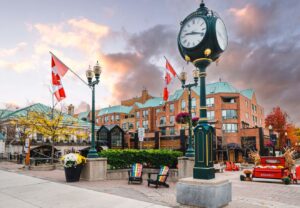
Oakville is consistently one of the most expensive suburban markets in Ontario. It appeals strongly to high-income families due to its waterfront location, strong school system, and proximity to Toronto.
The housing stock is dominated by detached homes, which keeps average prices elevated. Unlike denser urban centres, there is limited capacity to build large-scale high-rise housing, which restricts supply and keeps competition high.
Oakville’s pricing is largely driven by “spillover demand” from buyers priced out of Toronto but unwilling to move far outside the GTA.
3. Richmond Hill
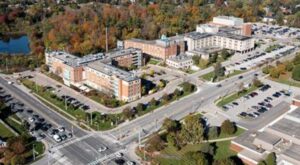
Richmond Hill is another high-cost GTA suburb where demand has steadily increased over the last two decades. It is particularly attractive to families due to its residential neighbourhoods, transit access, and relatively larger housing lots compared to Toronto.
However, zoning constraints and limited redevelopment space mean new supply is restricted. As a result, competition for detached homes remains intense, especially in established neighbourhoods.
Its location within commuting distance of Toronto continues to keep prices elevated.
4. Mississauga
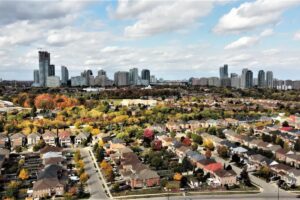
Mississauga is one of the largest cities in Ontario and a major part of the GTA housing market. It has a mix of condos, townhouses, and detached homes, but prices remain high due to proximity to Toronto and major employment hubs.
A major factor is transit and infrastructure connectivity. Being adjacent to Toronto and home to major commercial districts makes it a strong alternative for buyers who cannot afford downtown prices.
However, even with higher-density condo development, demand continues to outpace supply in many neighbourhoods.
5. Burlington
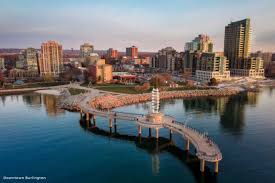
Burlington rounds out the list as one of Ontario’s most expensive mid-sized cities. It benefits from its location between Toronto and Hamilton, offering access to both job markets while maintaining a suburban lifestyle.
Waterfront properties along Lake Ontario significantly raise average home prices. At the same time, limited available land for new development restricts housing expansion.
Burlington has increasingly become a “destination city” for buyers looking for more space while still staying connected to the GTA.
What drives high prices across Ontario?
Even though these cities differ in size and character, the same structural pressures appear across all five:
- Population growth outpacing housing supply
- High immigration levels concentrated in the GTA
- Zoning restrictions limiting new housing density
- Strong job markets concentrated in Toronto and surrounding suburbs
- Limited land availability in established urban areas
A key misconception is that high prices are only caused by demand. In reality, supply constraints, especially slow construction and restrictive zoning, play an equally large role in keeping prices elevated.
Bottom line
Ontario’s most expensive housing markets are tightly clustered around the Greater Toronto Area. While each city has different lifestyle advantages, they all share one common reality: demand consistently exceeds supply.
If current trends continue, affordability will remain a major issue unless there are significant changes in housing construction, zoning policy, or population distribution across the province.